In the last year, I’ve become more and more curious about what people eat, and what they think they are eating. When you go to a fancy supermarket showing images of healthy people eating spinach and fresh fish swimming in pristine clear water, does this mean the foods being offered to you are somehow more healthy?
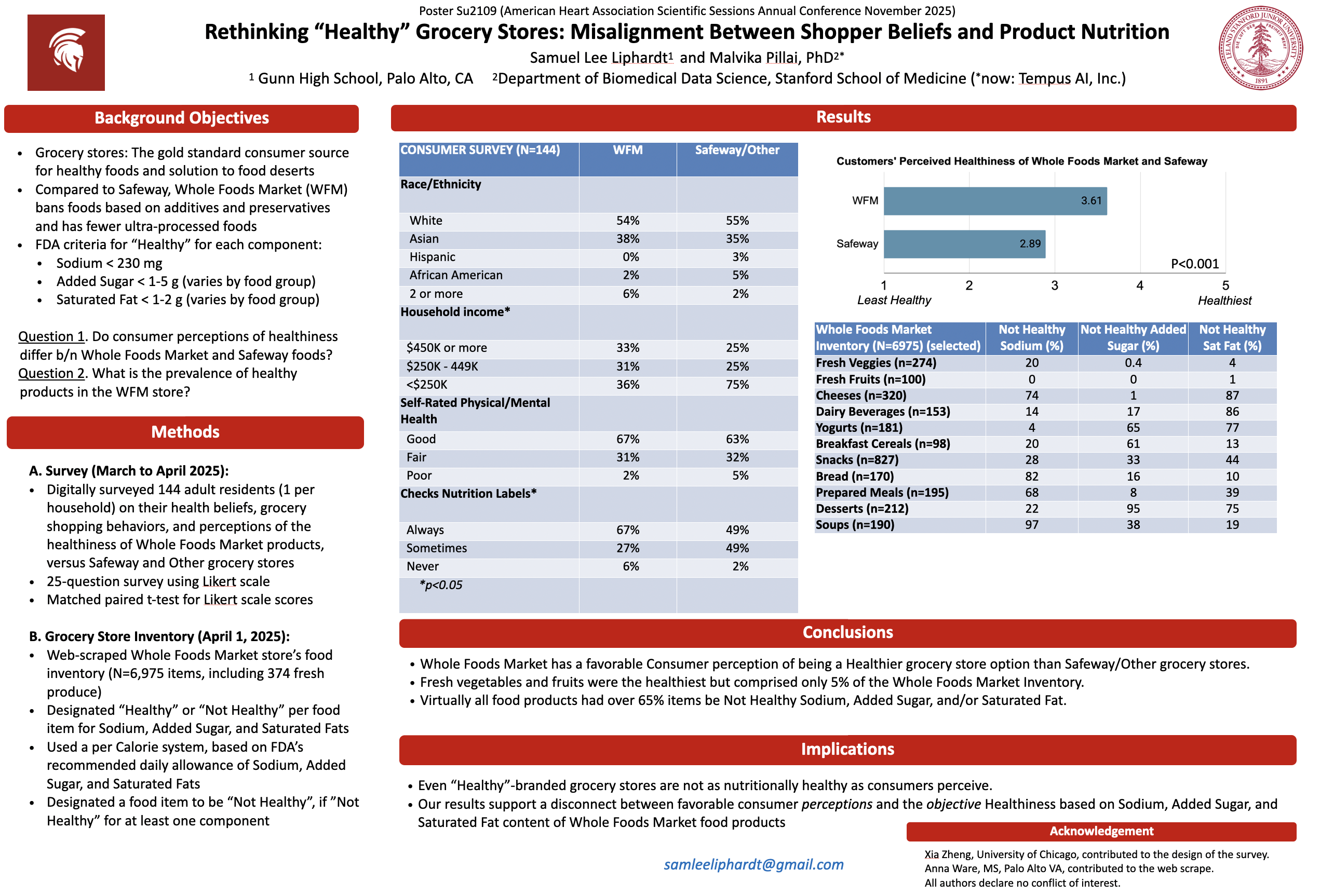
To look into a consumer perceptions of food healthiness at different supermarkets, I scraped web data from Whole Foods and Safeway. This gave me a large dataset of products, and their composition and estimated nutrition. Then, I asked people what they thought about the two supermarkets. respondents rated Whole Foods’ healthiness more favorably than Safeway’s (3.60 versus 2.89 on Likert scale, 5= healthiest, p<0.001). When asked to choose which is healthier, 60.4% perceived Whole Foods to be healthier than Safeway, while the rest responded “no difference” (p<0.015).
Fine, that does not tell us much, except that Whole Food’s advertising is working. The next step was to quantitatively assess the nutrition of thousands of products the two supermarkets actually sell people.
Well, I hate to have to tell you, but based on the large web scraped data, the opposite was true. A greater proportion of the Whole Foods store products were not healthy (4,451 items, or 55%) compared to the Safeway. I was really surprised – I’ve been going to the local Whole Foods for years because they sell “Whole” foods – it says so right in their name.
Despite Whole Foods’ favorable perception as a healthier grocery store option, analysis of the nutritional value of the products in the stores, being offered to you, reveal a disconnect between consumers’ perceptions of Whole Foods’ healthiness and Whole Foods’ objective nutritional value. Yup – it’s 2025 – healthy branded grocery stores – and grocery stores in general – may not be as nutritionally healthy as you may have previously assumed.
The work has since been published as an abstract in the Circulation journal, and was selected for public presentation at the 2025 American Heart Association meeting.
You can read more here: Circulation: Shopper Beliefs and Product Nutrition and you can download the full abstract with more data here.